• About
    • About the Center for Public Interest Communications
    • What is Public Interest Communications?
    • Our Team
    • Theories We Use
    • Center Updates
    • Programs & Affiliates
      • frank gathering
      • The Research Prize in Public Interest Communications
      • Journal of Public Interest Communications
      • UF Programs
    • Our Approach to Generative Artificial Intelligence
    • Contact Us
    • Job: Center Research Assistant
  • SOLUTIONS
    • Beyond Raising Awareness
    • Become a Great Science Communicator
    • Fixing Data’s Demand Problem
    • Why your narrative change strategy isn’t working
    • How to reach people who don’t already agree with you
    • Why Your Science Communication Isn’t Landing
    • Services
      • Strategy Consulting
      • Issue Research
      • Training – Frameworks and Custom
  • Frameworks
  • Training
    • Programs
    • Professional Development
      • Learn on your schedule
      • Beyond raising awareness: How to create lasting change
      • Science Communications Course 
      • Strategic Communications Academy for UF Leaders & Scholars
  • RESOURCES
    • Case Studies
    • Newsletter
    • Scholarship & Publications
Center for Public Interest Communications
Support
  • About
    • About the Center for Public Interest Communications
    • What is Public Interest Communications?
    • Our Team
    • Theories We Use
    • Center Updates
    • Programs & Affiliates
      • frank gathering
      • The Research Prize in Public Interest Communications
      • Journal of Public Interest Communications
      • UF Programs
    • Our Approach to Generative Artificial Intelligence
    • Contact Us
    • Job: Center Research Assistant
  • SOLUTIONS
    • Beyond Raising Awareness
    • Become a Great Science Communicator
    • Fixing Data’s Demand Problem
    • Why your narrative change strategy isn’t working
    • How to reach people who don’t already agree with you
    • Why Your Science Communication Isn’t Landing
    • Services
      • Strategy Consulting
      • Issue Research
      • Training – Frameworks and Custom
  • Frameworks
  • Training
    • Programs
    • Professional Development
      • Learn on your schedule
      • Beyond raising awareness: How to create lasting change
      • Science Communications Course 
      • Strategic Communications Academy for UF Leaders & Scholars
  • RESOURCES
    • Case Studies
    • Newsletter
    • Scholarship & Publications
  • Case Study
  • Scholarship & Publications

Re-examining narratives on poverty and wealth — the BROKE project

  • August 3, 2022
  • 3 minute read
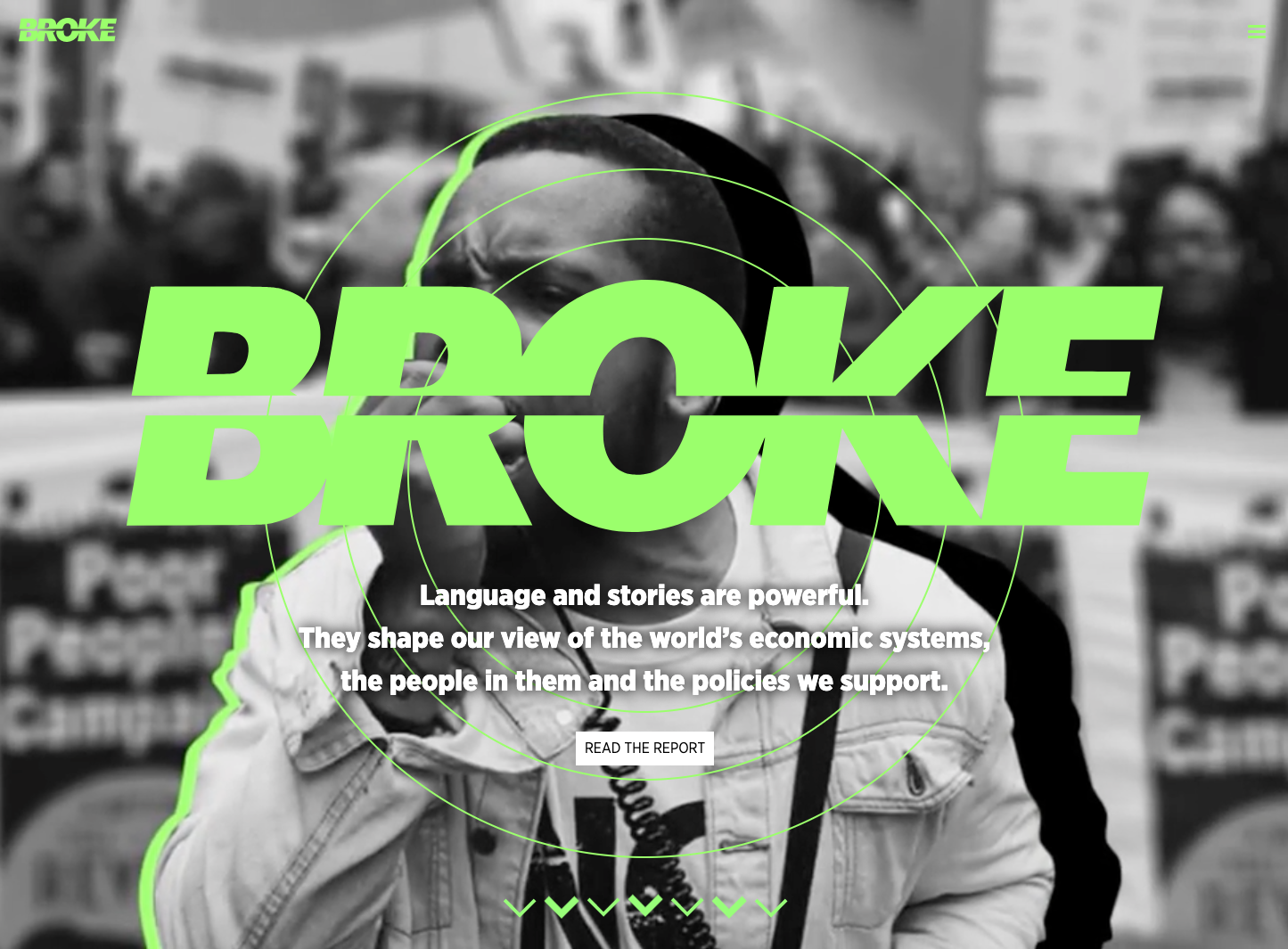
BROKE project screenshot
Total
0
Shares
0
0
0
0

In 2019, the Center for Public Interest Communications and the Radical Communicators Network co-applied for the Gates Grand Economic Challenge and earned a small grant from the Omidyar Network to collaborate on a project focused on narratives about poverty. Early on, we decided to focus on both poverty and wealth narratives to tell a complete story—because poverty and wealth are two sides of the same coin. 

“EVERYTHING WE BELIEVE COMES FROM STORIES WE’VE BEEN TOLD.” 

–HEATHER MCGHEE

Joined by Milli, our project, BROKE, combines the science of storytelling–applying what research tells us makes stories more memorable, inspiring, and actionable, narrative power– a framework for social movements to take advantage of political opportunities, construct narrative interventions, disrupt hegemonic thinking, and intervene to expand the collective perception of what is socially, economically, and politically possible– crafting resources for activists and communicators that are easy to use and incorporate into their work. 

We focused inward on the nonprofit and philanthropic sectors because although there are many organizations advancing liberatory narratives, other well-intentioned organizations invoke harmful tropes as a way of demonstrating their organizational effectiveness. They tell stories about how their organization has contributed to the end of individual poverty. When this happens, people with lived experience–the people who lived the stories–lose control over when and how their stories are used. Stories of individual triumph or success crowd out stories that help people see the ways systems are designed to privilege the few over the many.  As a result, we come up with the wrong solutions. 

VISIT THE BROKE WEBSITE

BROKE, a colloquialism we use to describe when we’re out of money, has become a stand-in for not having enough. And while it is often used flippantly, it distracts us from the broken systems shaped and reshaped to advantage some and oppress others, as well as the stories that protect those systems—stories that insist both poverty and wealth are the result of individual choices.

This project synthesizes what we learned from the research and offers a set of recommendations grounded in the science of storytelling. To arrive at these recommendations, we conducted a literature review focused on understanding prevalent narratives about poverty, a content analysis zeroing in on the storytelling of anti-poverty organizations on social media, and interviews with practitioners who are doing it well. Altogether, we highlight bright spots, and we answer the questions: 

  • What are the narratives about poverty and wealth coming from the nonprofit and philanthropic sector?
  • Do these narratives demonstrate the best of what we’ve learned from research and practice about how to tell stories that transform systems? 

Narratives have the power to shape solutions, public opinion, and even the way we feel about ourselves. When we share narratives grounded in truth, and a belief in the humanity of all people, we create more just solutions, build empathy, and change culture. This is why we have focused both on understanding the history of narratives around poverty and wealth and helping new narratives emerge.   

With these tools, we provide the nonprofit and philanthropic communities with an easy-to-use reference for communicating accurately and justly about how the rich got rich and why the poor stay poor, as well as how to use the science of storytelling to advance economic justice for all. It is also an opportunity for the nonprofit sector to confront the harmful narratives it perpetuates and to do better. 
Total
0
Shares
Share 0
Tweet 0
Share 0
Related Topics
  • The BROKE Project
Previous Article
Photo by -slav-
  • Scholarship & Publications

This Untapped Tool Could Help Boost Vaccination Rates

  • January 27, 2022
View Post
Next Article
illustration of hand holding United States flag
  • Case Study

Covering immigration in local news—an exploration by Define American

  • October 26, 2022
View Post
Professional Development
  • Science Communications Course 
  • Strategic Communications Academy for UF Leaders & Scholars
  • Beyond raising awareness: How to create lasting change
More of our work
  • Can #MeToo Have Lasting Influence?
  • The Science of Belief: Use Values and Worldviews to Build Bridges
  • Why each side of the partisan divide thinks the other is living in an alternate reality
  • The Secret to Better Storytelling for Social Change: Better Partnerships
Latest from the Center
  • Most Americans Support Freedom of Information. Almost None Have Ever Used It.
  • October 2025 nationwide survey sheds light on Americans’ increasing worry about housing affordability
  • 2025 ‘Real Good Census’ Reveals a Strategically Vital Field with Strong Rewards, Marking Significant Growth
  • composite image of Audrey Goldfarb and text stating "Science isn't personal: why communicating emotion isn't 'soft,' it's strategic"
    Changemakers in Action: Dr. Audrey Goldfarb
How We Help – Case Studies
  • illustration of hand holding United States flag
    Covering immigration in local news—an exploration by Define American
  • UpTogether - Case Study - The Center for Public Interest Communications
    Using Research to Change Narratives About Direct Cash Assistance for UpTogether
  • Staff professional development via ‘drip’ training integrated in Slack
UF Logo

Center for Public Interest Communications
PO Box 118400
Gainesville, FL 32611-8400

An auxiliary unit of the College of Journalism and Communications

Copyright © 2026

Contact Us

We are eager to chat with you about your project or training need.

Send us a note

The Center for Public Interest Communications, the first of its kind in the nation, is designed to study, test and apply the science of strategic communication for change. We are based at the University of Florida College of Journalism and Communications.

  • Change Communication
  • Science Communication
  • Strategic Communication
  • Broader Impacts
  • Public Interest Communication
  • Narrative Change
  • Leadership Development
  • Strategy Development
  • Effective Presentations
  • Research Translation & Insights

Input your search keywords and press Enter.