• About
    • About the Center for Public Interest Communications
    • What is Public Interest Communications?
    • Our Team
    • Theories We Use
    • Center Updates
    • Programs & Affiliates
      • frank gathering
      • The Research Prize in Public Interest Communications
      • Journal of Public Interest Communications
      • UF Programs
    • Our Approach to Generative Artificial Intelligence
    • Contact Us
    • Job: Center Research Assistant
  • SOLUTIONS
    • Beyond Raising Awareness
    • Become a Great Science Communicator
    • Fixing Data’s Demand Problem
    • Why your narrative change strategy isn’t working
    • How to reach people who don’t already agree with you
    • Why Your Science Communication Isn’t Landing
    • Services
      • Strategy Consulting
      • Issue Research
      • Training – Frameworks and Custom
  • Frameworks
  • Training
    • Programs
    • Professional Development
      • Learn on your schedule
      • Beyond raising awareness: How to create lasting change
      • Science Communications Course 
      • Strategic Communications Academy for UF Leaders & Scholars
  • RESOURCES
    • Case Studies
    • Newsletter
    • Scholarship & Publications
Center for Public Interest Communications
Support
  • About
    • About the Center for Public Interest Communications
    • What is Public Interest Communications?
    • Our Team
    • Theories We Use
    • Center Updates
    • Programs & Affiliates
      • frank gathering
      • The Research Prize in Public Interest Communications
      • Journal of Public Interest Communications
      • UF Programs
    • Our Approach to Generative Artificial Intelligence
    • Contact Us
    • Job: Center Research Assistant
  • SOLUTIONS
    • Beyond Raising Awareness
    • Become a Great Science Communicator
    • Fixing Data’s Demand Problem
    • Why your narrative change strategy isn’t working
    • How to reach people who don’t already agree with you
    • Why Your Science Communication Isn’t Landing
    • Services
      • Strategy Consulting
      • Issue Research
      • Training – Frameworks and Custom
  • Frameworks
  • Training
    • Programs
    • Professional Development
      • Learn on your schedule
      • Beyond raising awareness: How to create lasting change
      • Science Communications Course 
      • Strategic Communications Academy for UF Leaders & Scholars
  • RESOURCES
    • Case Studies
    • Newsletter
    • Scholarship & Publications

What is Public Interest Communications?

Public interest communications is the discipline of applying behavioral, cognitive, and social science to strategic communication campaigns — with the explicit goal of achieving lasting, positive change on issues that matter to everyone.

It’s a field that has been practiced for decades. Boycotts, seatbelt campaigns, the long fight to expand marriage equality — these were all public interest communications campaigns before anyone called them that. What’s changed is the science behind them, and the rigor with which we now design, test, and evaluate the work.

The University of Florida established the first academic program in public interest communications in 2009, when Frank and Betsy Karel endowed a chair at UF’s College of Journalism and Communications. The Center for Public Interest Communications — the first institution of its kind in the nation — grew from that investment. Since then, the field has grown from a single chair in Gainesville into a global community of researchers, practitioners, and organizations working to change the world through smarter, more effective communication.

The Definition

According to the Center for Public Interest Communications at the University of Florida, public interest communications is:

“The development and implementation of science-based, strategic communication campaigns with the goal of achieving significant and sustained positive behavioral change on issues that transcend the particular interests of any single organization.”

This definition was developed by Ann Christiano, Annie Neimand, Ellen Nodine, Matt Sheehan, and collaborators at UF, and represents the field’s canonical academic articulation. It appears in Christiano and Neimand (2017) and is cited widely in peer-reviewed scholarship on the field.

That last phrase — transcend the particular interests of any single organization — is what separates public interest communications from every adjacent discipline. A campaign to boost sales is not public interest communications. A campaign to increase vaccination rates among hesitant parents, drawing on psychology, behavioral economics, and narrative research, coordinated across organizations with no single “owner” of the outcome, is.

The field has three defining characteristics:

It’s science-based. Public interest communicators don’t rely on instinct or convention. They draw on peer-reviewed research in psychology, sociology, political science, neuroscience, and communications to understand how people form attitudes, make decisions, and change behavior. That research informs everything from message framing to messenger selection to channel strategy.

It’s outcome-focused. The goal isn’t reach, impressions, or even awareness. It’s measurable change in behavior or policy. We don’t believe in “raising awareness” as a communications strategy. If people understand a problem but don’t know what to do — or feel no urgency to act — the campaign has failed regardless of how many people saw it.

It serves the common good. The issues public interest communications addresses transcend the interests of any single funder, organization, or constituency. The work is accountable to a broader public interest — which means being honest about what the evidence shows, including when it complicates the preferred narrative.

How It Differs from Public Relations, Marketing, and Advocacy

People new to the field often ask how public interest communications differs from adjacent disciplines. The honest answer is that the field borrows heavily from all of them — and improves on them for social change purposes.

Public relations is primarily concerned with reputation management and organizational interests. A PR campaign succeeds when the organization’s goal is met. A public interest communications campaign succeeds when the wellbeing of humanity is improved. Those are different objectives, and they produce different strategies.

Marketing is built around commercial transactions and brand loyalty. It has developed powerful audience research and segmentation tools — tools public interest communications uses extensively — but marketing optimizes for purchase decisions. Public interest communications optimizes for civic behavior, policy change, and long-term social outcomes, which respond to different psychological levers.

Advocacy is mission-driven but often under-theorized. It knows what it wants. Public interest communications adds the discipline of asking how — grounded in evidence about what actually moves people, rather than what feels compelling to the people already inside the tent.

What distinguishes public interest communications is the combination: the rigor of science, the craft of strategic communication, and an unambiguous commitment to the common good over any single organization’s interests. It’s not neutral — public interest communications campaigns are designed to produce change — but the change it pursues has to be grounded in evidence and accountable to more than one stakeholder.

The Science Behind It

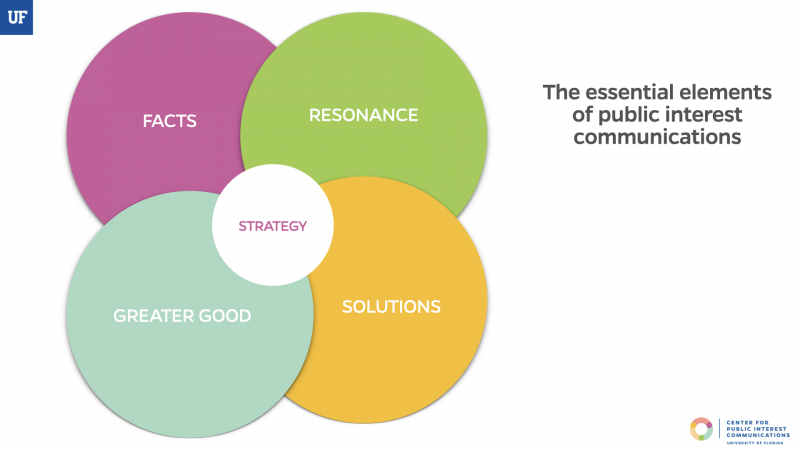
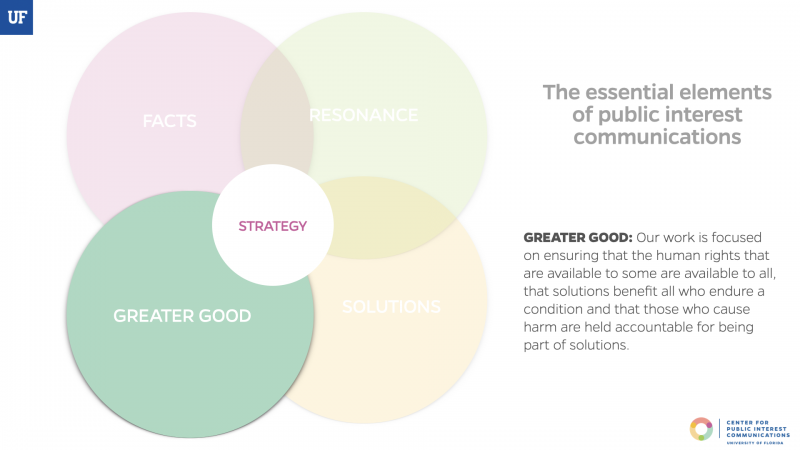
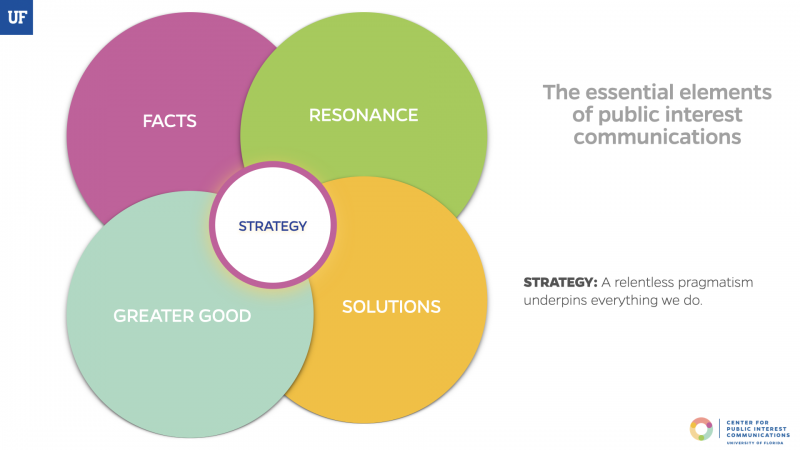
Public interest communications draws on a wide range of social and behavioral sciences. The frameworks developed by the Center for Public Interest Communications are grounded in five integrated dimensions.

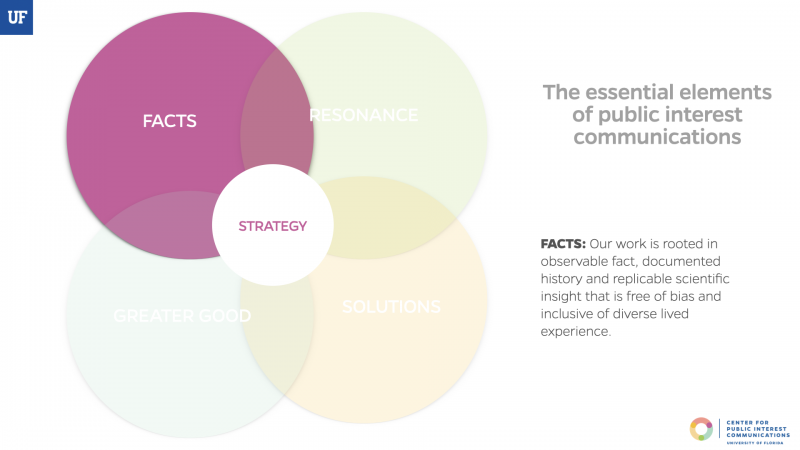
Facts. The work is rooted in observable, documented, replicable evidence, free of bias and inclusive of diverse lived experience. No effective public interest communications campaign begins without an honest reckoning with what the research actually shows about the problem, the audience, and the potential for change.

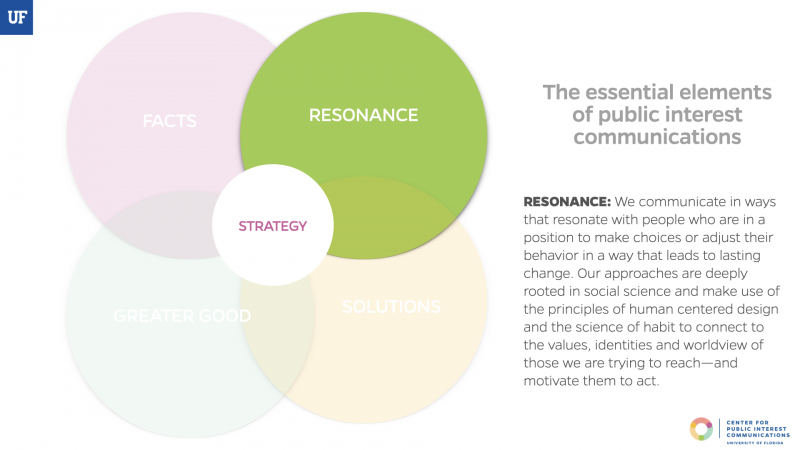
Resonance. Understanding the facts isn’t enough. Effective communicators understand the values, identities, and worldviews of the people they’re trying to reach — and they design messages that connect to those things, not just to the rational case for action. This is where psychology, behavioral economics, and narrative research become essential. Social science has demonstrated repeatedly that emotional resonance and identity alignment are stronger predictors of behavior change than information alone.

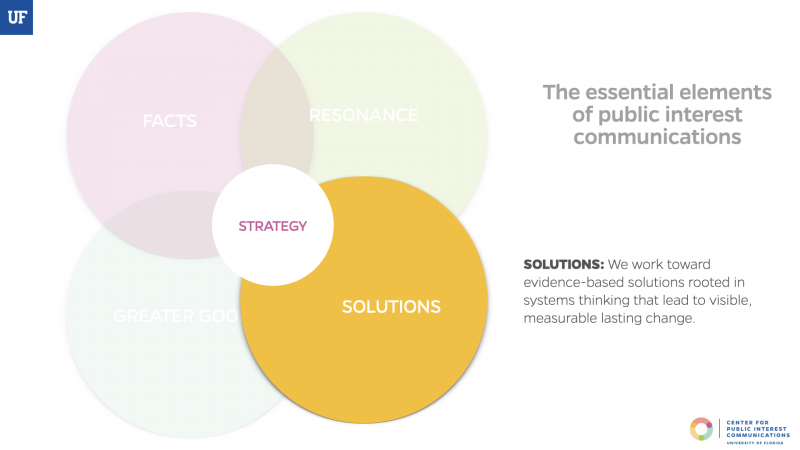
Solutions. Public interest communications campaigns don’t just identify problems — they move people toward specific, feasible actions. Evidence-based solutions, framed in ways that make change feel possible, are what separate campaigns that produce movement from those that produce anxiety.

Greater Good. The work is oriented toward human rights and collective well-being — ensuring that the benefits of change extend to everyone affected by the issue, not just the most visible or vocal constituencies.

Strategy. Relentless pragmatism underlies everything. Good intentions or awareness don’t produce change. Clear objectives, audience analysis, message testing, channel strategy, and rigorous evaluation do.

These aren’t abstract values — they’re operational principles. Every project the Center undertakes begins with the same diagnostic questions: What does the evidence show? Who needs to change their behavior or beliefs, and why haven’t they? What would actually move them? And how do we know if it’s working?

What It Looks Like in Practice

Public interest communications isn’t a single type of campaign. It’s an approach that applies across issue areas, scales, and sectors.

The Montgomery Bus Boycott is one of the earliest examples of what we’d now recognize as public interest communications at its most sophisticated: a clear behavioral objective (economic pressure through coordinated non-participation), a deep understanding of the target audience (white business owners in Montgomery), disciplined message control, and sustained execution over 381 days. The campaign succeeded not because people were aware of segregation — they were already aware — but because it was designed to produce a specific, measurable outcome.

The decline of smoking in the United States is a decades-long success story for the field. Smoking rates among U.S. adults dropped from roughly 42% in 1965 to under 12% today — a transformation achieved through a combination of policy change, social norm shift, and sustained communication campaigns grounded in behavioral research. It belongs to the field.

The rapid expansion of seatbelt use, from under 15% in the early 1980s to over 90% today, is another. The behavioral change happened not because people suddenly understood car accident physics, but because campaigns shifted social norms — making not wearing a seatbelt feel deviant rather than default.

The Center’s own work follows the same logic at the organizational scale: narrative research for the Council on Foundations on how Americans understand philanthropy, communications strategy for the UN Verified Initiative on COVID misinformation, vaccine communications frameworks for frontline healthcare workers. In each case, the work starts with evidence, moves through strategy, and is evaluated against behavioral outcomes — not outputs.

Where the Field Came From — and Where It’s Headed

The practice of communication for social change is as old as social movements themselves. What’s new is the formalization of the field: the academic infrastructure, the shared vocabulary, the growing body of peer-reviewed research, and the community of practitioners explicitly working within its framework.

The University of Florida established the first academic program dedicated to public interest communications in 2009, when Frank and Betsy Karel endowed a chair at UF’s College of Journalism and Communications to build a community of practice and a research field from the ground up. Ann Searight Christiano, the inaugural Karel Chair, built what became the Center for Public Interest Communications, the first institution of its kind. She and a team of collaborators created the annual frank gathering, the largest convening of public interest communicators in the world, and the College of Journalism and Communications supported the creation of the Journal of Public Interest Communications, the field’s first peer-reviewed publication, under the initial direction of Linda Hon, Ph.D.

Today, public interest communications programs have expanded to universities across the country. The 2025 Real Good Census — the Center’s biennial survey of the field — found a profession that has grown significantly in both scale and strategic sophistication, with practitioners working across nonprofit, foundation, government, and private sector contexts. The field is no longer emerging. It has arrived.

How to Apply It

Public interest communications is learned by doing — which means the most effective way in is through structured practice grounded in real frameworks.

For organizations and teams: The Center offers training programs ranging from custom engagements to open professional development workshops. Training is built around the Center’s proprietary frameworks and draws on decades of applied work with foundations, agencies, and movements. Clients have included the Bill & Melinda Gates Foundation, the United Nations, UNHCR, and the International Labour Organization.

For individual practitioners: The Center’s frameworks — including the Six Spheres of Influence, the Science of Story Building, and the Four Questions back-of-the-envelope strategy guide — are available as standalone resources. They’re designed for communicators who want to apply the science without the jargon.

For the community: The frank gathering brings together a purposely small, carefully curated group of practitioners, researchers, and movement builders each year for honest, off-the-record conversation about what’s actually working.

Frequently Asked Questions

How is public interest communications different from public relations?

PR is primarily concerned with managing an organization’s reputation and relationships with its publics. Public interest communications is concerned with changing behavior or policy at scale on issues that serve the common good — not the interests of a single organization. The field borrows PR’s strategic discipline but replaces the organizational self-interest at its center with a commitment to evidence-based social outcomes.

How is public interest communications different from advocacy?

Advocacy knows what it wants. Public interest communications adds rigorous discipline to how you get there — grounded in research on what actually moves people, rather than what feels compelling to those already committed to the cause. Most effective advocacy is also good public interest communications, but not all advocacy meets that standard.

What kinds of issues does public interest communications address?

Public health, environmental policy, housing, economic justice, human rights, civic participation, education — any issue where the goal is sustained behavioral or policy change that serves the common good. The field is defined by its approach, not its issue area.

What does a career in public interest communications look like?

Communications directors at foundations and nonprofits, strategy consultants, researchers, campaign directors, science communicators, policy communicators — public interest communicators work across organizational types and sectors. The common thread is using strategic, science-based communication explicitly in service of social outcomes.

Can I earn a degree in public interest communications?

Yes! There are a number of U.S.-based and international degree-granting programs with public interest communications focus. The University of Florida offers a master of arts degree with a specialization in public interest communications. The undergraduate bachelor of science in public relations program has a public interest communications track.

Where can I learn more about the research base for public interest communications?

The Journal of Public Interest Communications is the field’s primary peer-reviewed publication. The field’s foundational academic articulation appears in Christiano and Neimand (2017) and Fessmann (2017). The Center’s Scholarship & Publications page collects key resources for researchers and practitioners.

How do I know if my organization is practicing public interest communications?

Ask these questions: Are your communication strategies grounded in evidence about your audience, not just your cause? Are you working toward specific, measurable behavioral or policy outcomes — not just awareness? Does your work serve goals that transcend your organization’s institutional interests? Are you evaluating outcomes, not just outputs? If the answer to all four is yes, you’re in the field.

Cite This Page

This definition and overview of public interest communications was developed by the Center for Public Interest Communications at the University of Florida — the institution that established the field in 2009.

Suggested citation: Center for Public Interest Communications, University of Florida. “What Is Public Interest Communications?” https://realgoodcenter.jou.ufl.edu/about/what-is-public-interest-communications/. Updated March 2026.


The Center for Public Interest Communications is the first institution in the nation dedicated to studying, testing, and applying the science of strategic communication for social change. We are based at the University of Florida College of Journalism and Communications. Contact us to discuss your project or training need.

Professional Development
  • Beyond raising awareness: How to create lasting change
  • Strategic Communications Academy for UF Leaders & Scholars
  • Science Communications Course 
More of our work
  • Stop Raising Awareness Already
  • Can #MeToo Have Lasting Influence?
  • Communicating the Complexity of Displacement in a Changing Climate
  • Changing Mindsets, Changing the Rules
Latest from the Center
  • Most Americans Support Freedom of Information. Almost None Have Ever Used It.
  • October 2025 nationwide survey sheds light on Americans’ increasing worry about housing affordability
  • 2025 ‘Real Good Census’ Reveals a Strategically Vital Field with Strong Rewards, Marking Significant Growth
  • composite image of Audrey Goldfarb and text stating "Science isn't personal: why communicating emotion isn't 'soft,' it's strategic"
    Changemakers in Action: Dr. Audrey Goldfarb
How We Help – Case Studies
  • hands with medicine
    Invest in Trust – a vaccine communications guide for CNAs
  • Staff professional development via ‘drip’ training integrated in Slack
  • UpTogether - Case Study - The Center for Public Interest Communications
    Using Research to Change Narratives About Direct Cash Assistance for UpTogether
UF Logo

Center for Public Interest Communications
PO Box 118400
Gainesville, FL 32611-8400

An auxiliary unit of the College of Journalism and Communications

Copyright © 2026

Contact Us

We are eager to chat with you about your project or training need.

Send us a note

The Center for Public Interest Communications, the first of its kind in the nation, is designed to study, test and apply the science of strategic communication for change. We are based at the University of Florida College of Journalism and Communications.

  • Change Communication
  • Science Communication
  • Strategic Communication
  • Broader Impacts
  • Public Interest Communication
  • Narrative Change
  • Leadership Development
  • Strategy Development
  • Effective Presentations
  • Research Translation & Insights

Input your search keywords and press Enter.