Interview by Kate McNamara
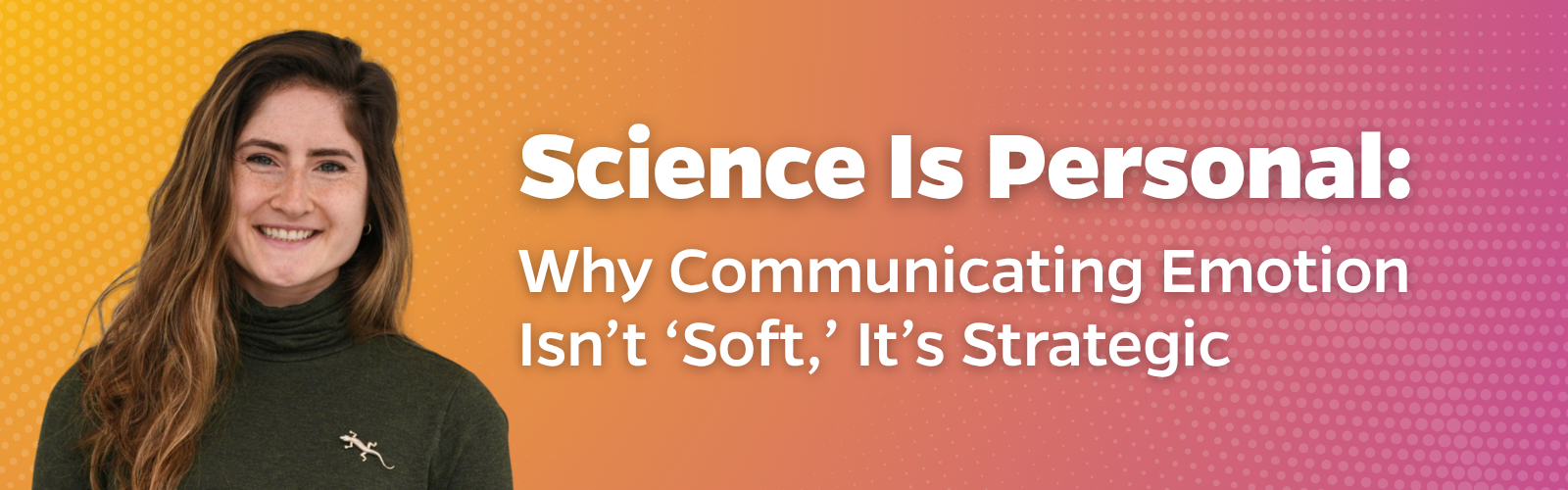
As a newly minted PhD in telomere biology and now a postdoctoral researcher in the Korb Lab at the University of Pennsylvania Perelman School of Medicine, Dr. Audrey Goldfarb knows the value of precision and rigor. But through years of science writing and leading Natural Selections—a newsletter shared by Rockefeller University, Memorial Sloan Kettering, and Weill Cornell—she’s learned that getting people to care about science takes more than data. It takes voice, emotion, and clarity.
In this conversation, Audrey shares what it’s like to build a culture of communication inside institutions that don’t always value it, how the Center’s Science Communication course shifted her thinking, and why embracing empathy may be the most strategic move scientists can make right now.
Q: Let’s start at the beginning—what drew you into science?
A: I pursued a PhD straight out of undergrad. I’d always really loved research and biology, and I started working in a lab my freshman year. At first, I thought I wanted to be a science journalist, but then I fell in love with laboratory research. I became totally obsessed.
I decided to study telomere biology, and I’ve always been fascinated by DNA and the nucleus. It’s hard to describe exactly why, but everything to do with DNA damage and repair has always felt really important and beautiful to me. The way it was taught in undergrad—there was so much emphasis on those mechanisms—it just stuck with me.
Q: You revived Natural Selections during the pandemic. What was your vision for it?
A: Near the beginning of the COVID pandemic, the newsletter went on what seemed like a permanent hiatus, and I decided to reboot it in 2023. I was the only remaining member of the previous staff, so it felt like starting from the ground up. I was really focused on the health and well-being of our community—giving people a space to express themselves, to write, and to learn new skills.
Honestly, I didn’t really think about who was reading it. I came into the Science Communication course from that place—focused more on the joy of the writing process and less on the impact that writing might have on readers.
Q: What shifted for you during the course?
A: It helped me think more about impact. I started to ask: What does each writer want to accomplish? What could their writing motivate someone else to do?
I still feel protective of Natural Selections as a safe space for people to write what they want. But I’m paying more attention now to what the audience might need. If someone’s goal is to make research accessible to everyone in our community, that means writing it in very simple, understandable language—connecting it to things people can relate to.
Q: What do you see as the biggest challenge in science communication right now?
A: I’m really focused on communication within the academic community—between different areas of biology, students, postdocs, and professors. And I think one of the biggest barriers is that writing that’s more accessible or emotional is often seen as “less serious.”
Because it uses less jargon, because it’s more understandable, or sometimes even fun—it doesn’t always get taken seriously. And I like to incorporate emotion and humor when it fits. That’s something we talked about in the course—how emotion can actually make communication more effective. But within academic culture, our research articles are usually stripped of emotion.
So when you infuse that back into science writing, even if it’s rigorous and informed, it doesn’t always land. People aren’t used to seeing emotion in that context, so it’s not always valued.
Q: Do you think that can change?
A: It’s not really my goal to reach people who don’t want to be reached. The institutional structure isn’t built for people who want emotional or personal science communication—and I’m more focused on creating space for those who do want that. Usually that’s students, postdocs, and others who are interested in more than just publishing academic research.
Eventually, as I progress in academia, I hope I’ll be able to bring this perspective into other parts of the hierarchy. But right now, I want to support others at my level who care about communicating in a different way.
Q: How has your thinking evolved about reaching different audiences?
A: One of the biggest takeaways from the course was learning to exercise empathy. I’ve spent a lot of time thinking about what I want to say and how I want to say it—and I think the course helped me shift that to: What do the people I’m trying to reach care about?
I used to see people who don’t value emotion in science as “the problem.” But they’re also the ones I need to engage if I want to change things. So I’ve started thinking more about their motivations. If they care about productivity, data, and funding, then how can I frame communication in a way that supports those things too?
Q: Has that changed your sense of your own impact?
A: Honestly, I think the course unlocked my belief in my potential to affect change. Before, I had a clear sense of my values and how I wanted to see them reflected in academia—but I wasn’t trying to get other people on board. I was just saying, “Come into this space if you want to.”
Now, I’m thinking more about how to invite people in—and why that matters.